Bengaluru: Artificial intelligence is no longer a subject confined to research laboratories or specialized technology teams. From customer service and financial analysis to software development and everyday office tasks, AI-powered tools are changing how work gets done. For students preparing to enter the workforce and professionals considering new skills, the question is increasingly about what they need to learn and how to apply that knowledge.
With AI-related courses becoming more widely available, choosing the right program can be confusing. Terms such as generative AI, machine learning, prompt engineering and agentic AI frequently appear in course descriptions, although they refer to different concepts and technical capabilities.
Understanding these differences is an important starting point.
Generative AI is commonly associated with tools that create text, images, computer code and other content in response to instructions. Agentic AI takes this further by enabling systems to perform sequences of tasks, use external tools and make decisions within defined boundaries.
For example, a conventional AI assistant may help draft an email or summarize a report. An agentic system could potentially retrieve information from approved sources, organize findings, prepare a document and initiate a workflow, subject to the permissions and safeguards built into it.
This distinction matters for anyone planning to work with AI applications. Knowing how to write effective prompts can be useful, but developing reliable systems generally requires additional knowledge of programming, data handling, software integration and testing.
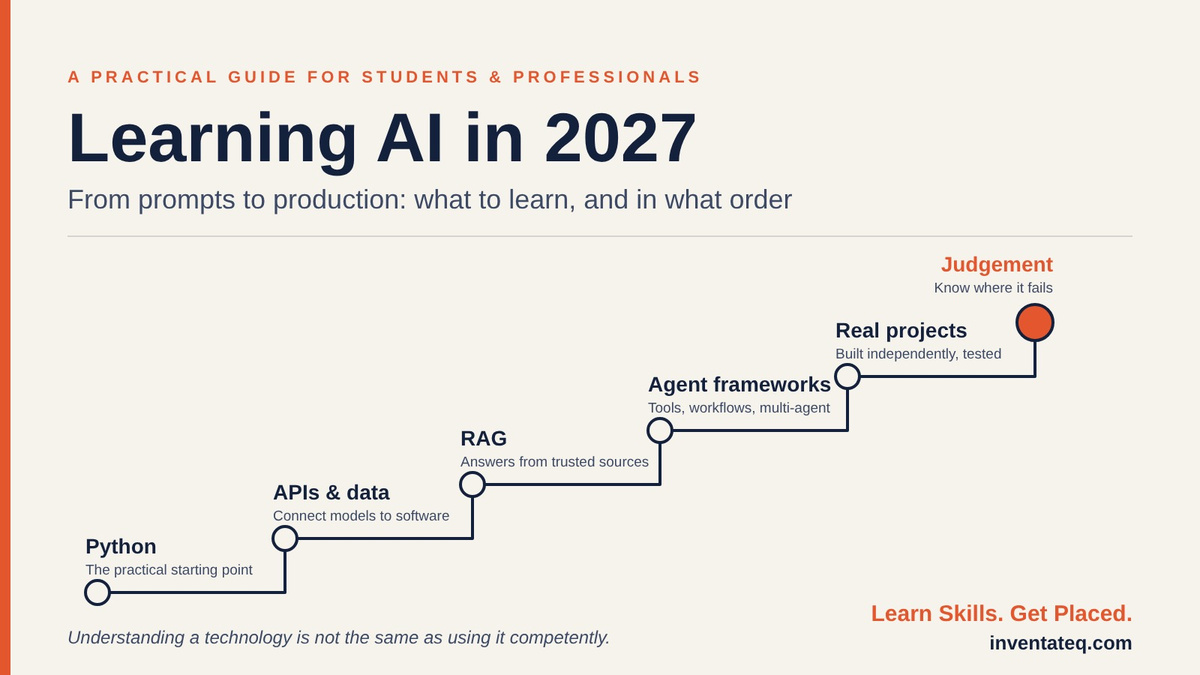
Python is often a practical starting point because of its extensive use in AI development. Learners may then progress to application programming interfaces (APIs), language models, retrieval-augmented generation (RAG) and frameworks such as LangChain and LangGraph.
RAG is particularly relevant because it allows applications to retrieve information from selected documents or databases before generating responses. This can make AI tools more useful in situations where information must come from specific sources, although the results still require appropriate validation.
Training providers have begun incorporating these subjects into their curricula. Bengaluru-based Inventateq, for instance, lists Artificial Intelligence and Agentic AI programs covering Python, prompt engineering, RAG, vector databases, API integration and multi-agent workflows.
Its Artificial Intelligence Course in Bangalore includes practical work involving research and data analysis agents, while the Agentic AI Training in Bangalore introduces frameworks such as CrewAI and AutoGen, alongside application development and deployment tools.
Such course outlines also illustrate how AI education is moving beyond basic familiarity with chatbots towards the technical processes involved in building applications.
However, the presence of popular technologies in a syllabus does not automatically indicate the quality of training. Students should examine how much time is devoted to practical exercises, whether instructors explain the underlying concepts and what learners are expected to build independently.
A useful way to assess a program is to ask for examples of completed projects. These might include a document-search assistant, a research tool that retrieves information from multiple sources or an application that automates a clearly defined business process.
Projects can also reveal whether learners understand the limitations of the technology. AI-generated information can be inaccurate, external data may contain sensitive material and automated systems can produce unintended outcomes if permissions are not properly controlled.
Consequently, responsible AI development should include testing, data privacy, human oversight and methods for checking system outputs. These subjects are particularly important when applications are used in financial services, healthcare, recruitment or other settings where errors may have significant consequences.
Career expectations deserve equal attention. Completing a short course does not, by itself, qualify someone for an AI engineering position. Employers may assess programming ability, problem-solving skills, project experience and understanding of software development fundamentals.
Students without a technical background may benefit from beginning with Python, basic statistics and introductory AI concepts before moving into advanced agent-based development. Professionals already familiar with software engineering or data analytics may be better positioned to explore specialized applications.
Course duration, learning format and placement assistance are other considerations. Prospective learners should clarify the number of instructor-led hours, access to mentors, project requirements, additional costs and the exact nature of any career support before enrolling.
The growing availability of AI education presents opportunities, but it also places greater responsibility on learners to distinguish between understanding a technology and being able to use it competently.
As AI systems become more capable, the most valuable learning may come not from memorizing the names of emerging tools, but from understanding how they work, recognizing where they fail and developing the judgement to use them appropriately.
For students and working professionals, that foundation is likely to remain useful even as individual platforms, frameworks and technologies continue to change.
For more information, visit www.inventateq.com.