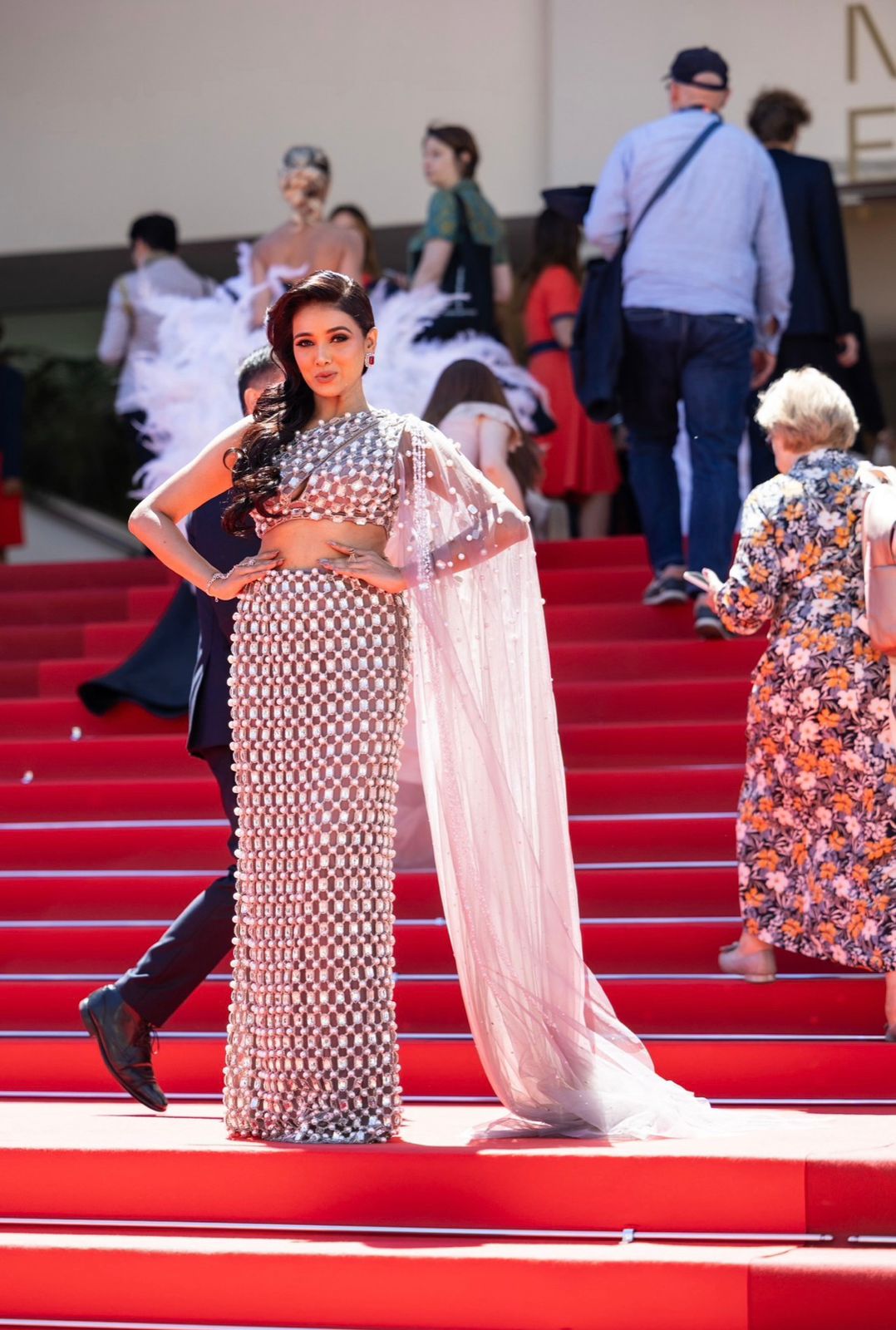
Kalpana Shukla’s appearance at Cannes 2026 became headline news not only for her presence but for the couture that framed it. Wearing a custom creation by Manish Malhotra, she transformed a red‑carpet look into a study of craft, intent and identity — an intersection where designer technique and the wearer’s journey amplified each other.
Design as dialogue
The gown began as a dialogue between silhouette and surface. Malhotra’s signature approach — precise tailoring married to theatrical detailing — established the piece’s architecture. A sharply cut one‑shoulder bodice set a disciplined, almost sculptural tone; from there a sweeping train unfurled, layered with pearls, hand‑embroidered mirror work and dense zardozi. The result was a garment that read differently at varying distances: up close a showcase of Indian artisanry, from afar a metallic, cinematic wash that caught the festival’s flashbulbs.
Craftsmanship foregrounded
What made the dress newsworthy was the visible labour embedded in it. Zardozi and mirror work are centuries‑old crafts requiring time and skilled hands; here they were adapted into a couture grammar that suited international red‑carpet optics. The placement of each pearl and mirror was calibrated to catch light and create three‑dimensional depth. Metallic fabrics and carefully placed accents refracted flash photography into textures rather than glare, turning movement into a shifting mosaic.
The designer–wearer synergy
A couture piece is only as memorable as the person who carries it. Malhotra’s design offered a framework; Kalpana provided the narrative. Her disciplined posture and stage presence, honed through years as a dietician focused on wellness and body confidence, made the gown feel harnessed rather than simply worn. This synergy — of a designer’s intent and a wearer’s command — converted visual impact into cultural resonance.
Modernising heritage
The gown was a study in modernised heritage. Traditional techniques like zardozi and mirror work were not replicated as archival pastiche but reinterpreted with contemporary lines and metallic palettes. That adaptation showed how Indian artisanal methods can be scaled and styled for global couture without losing their intrinsic value. In effect, the dress functioned as a cultural translator: wholly modern in form, distinctly Indian in detail.
Image strategy and optics
On a practical level, the gown was engineered for cameras. The one‑shoulder cut framed Kalpana’s profile for profile shots; the train’s reflective elements read well in motion reels and stills; the color and sheen were chosen to pop against the Cannes red carpet backdrop. These choices amplified media reach, creating images that circulated widely and shaped the narrative beyond the festival evening.
A platform for stories
Because of the dress’s craftsmanship and Kalpana’s story, the look did more than flatter—it told. It linked Kanpur‑rooted identity, professional discipline, and haute couture craftsmanship. It also elevated conversations about Indian textiles in contemporary fashion discourse, prompting coverage that ranged from technical appreciation of embroidery to conversations about representation and soft power.
Why this mattered
- Design visibility: A globally recognised designer used Indian artisanal techniques in a headline Cannes gown.
- Empowered storytelling: The wearer’s background and presence made the look culturally meaningful.
- Craft spotlight: Zardozi and mirror work received renewed attention in a haute couture context.
- Media impact: The gown’s visual engineering maximised press and social reach.
Conclusion
Kalpana Shukla’s Cannes moment was inseparable from the Manish Malhotra gown she wore. The dress was more than ornamentation; it was a crafted vehicle for storytelling — where designer technique, artisan labour and the wearer’s own narrative combined to create an image that resonated across borders. In that synthesis, couture became a tool of cultural expression, and the red carpet became a platform where Indian craft and personal achievement met, meaningfully.