
29 July 2026. It’s the first week of an automation engineer working at a tech company. The manager comes in, hands over a list of features to be tested, and says: “Our team uses AI to write most of the test scripts.”
This is becoming more common in software testing teams, as AI tools are being adopted to assist with tasks such as test generation, automation, and maintenance. But for fresh graduates, this shift can feel completely new. After graduating from college with theoretical knowledge, lab experience, and some project experience, students enter IT companies as interns. For fresh graduates, the industry is quite different from what they have learned in college. When it comes to software testing, they start learning both manual testing and automation testing. Since AI adoption in software development is increasing, companies are exploring and integrating AI tools into testing workflows to improve efficiency.
If you are a graduate seeking software automation testing roles, this article will help you understand the current phase in software testing and how to utilize generative AI in software testing.
The Next Era of Software Quality
Testing used to be a time-consuming process. Manual testers would click on each UI interface, sit with a spreadsheet, write test cases, and mark bugs one by one. That was the process. It was a slow and repetitive job, doing the same tasks over and over again. There was always a shortage of resources. But since there was no better way, companies tolerated it then.
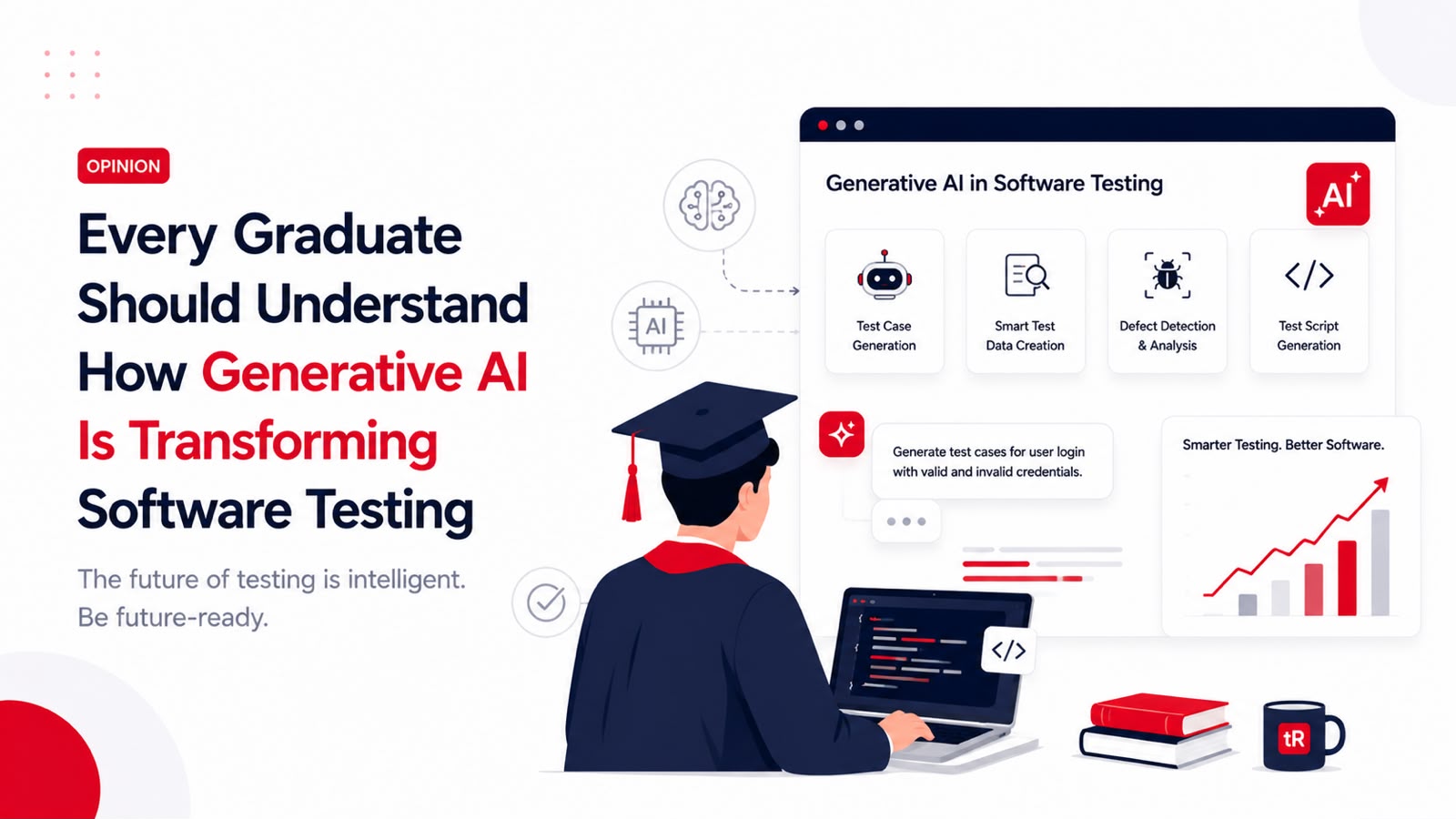
Now, generative AI is changing software testing practices, but adoption varies across companies and is still evolving. Today, AI tools can analyze application requirements, user flows, and existing information to assist with testing tasks. They can create more test cases within a short time. For instance, many organizations are using generative AI-based test automation tools like testRigor for software testing. Instead of writing traditional test scripts, we can describe the test case in simple English, and the tool can help create and execute tests. This is a major revolution in software testing.
How AI Testing Impacts Every Career
Does this shift in software testing only matter to Computer Science graduates? No, let’s see why.
Tomorrow’s business majors will be managing large product teams. Every company will have engineers, project managers, and support specialists. Engineers have technical expertise. But others are non-technical.
Generative AI tools make some testing activities easier to access for everyone, including non-technical team members. But effective software testing still requires technical understanding, domain knowledge, and human judgment. Hence, some non-technical team members may contribute to AI-assisted testing workflows, but complete ownership of automation usually still depends on technical expertise.
How AI Makes Software Testing Smarter
- Test case generation: Humans don’t need to write every step to test a functionality. AI will analyze the application. It will automatically create test cases based on the context we provide. We can also modify the test cases if required.
- Test case writing in natural language: Some modern automation platforms allow us to write test cases in plain English. AI will convert it into an executable test that the system understands.
- Self-healing tests: When the layout or design of an application changes, traditional automated tests could fail because they depend on DOM selectors and XPaths. The DOM structure (XPaths) or the DOM selectors may change at any time. Some AI-based testing tools can adapt to those changes (self-healing) and reduce maintenance effort. But self-healing does not eliminate all test maintenance issues.
- Predictive analysis: AI can assist teams by analyzing historical data and patterns. But predictions are not guaranteed to identify every future issue.
Of course, AI is making software testing smarter. But none of this is a substitute for human intelligence and analytical thinking. There should always be a human in the loop for decision-making because AI may sometimes produce wrong logic. Ultimately, AI is just a tool to enhance your skills, not a replacement for your intelligence.
The Future Belongs to Those Who Understand AI
According to the Future of Jobs Survey, skill gaps are the biggest challenge slowing down business transformation. Around 63% of employers say that a lack of the right skills will be a major barrier between 2025 and 2030. That’s why companies are actively looking for candidates with the right skills to do the job. Generative AI skills are becoming more valuable across technology roles.
So, what can new graduates do? If your college curriculum does not cover enough to make you ready for the AI-led IT industry, start enrolling in the fundamental courses that can train you well as a beginner professional. For example, learn the essential prompt engineering skills for modern QA professionals. Similarly, start learning all basic concepts in AI-based software test automation. Explore all leading modern AI-based test automation tools to understand the technology better. Hands-on practice with free tiers or open-source options can help you stand out in interviews and early projects in the company.
Your First Day at Work Should Not Be a Surprise
Technical universities prepare students with a strong theoretical foundation in technology. But they often fail to teach how they will be working in the industry after graduation.
The AI revolution in software testing is something that you need to be aware of before getting into the industry. Many companies are experimenting with and adopting AI tools in software development and testing workflows, though adoption levels differ across organizations.
These changes are influencing many workplace processes, but the extent of the impact differs by company and role. Therefore, it’s always better to have a basic understanding of how the industry operates. So, you will be prepared to start working when your leadership teams in the company assign you some tasks.
To have a smooth transition to the industry after graduation, you need to be curious to look beyond the college syllabus. Start now. Competition is high, and industries are looking for candidates who can utilize AI efficiently in their workflow.
